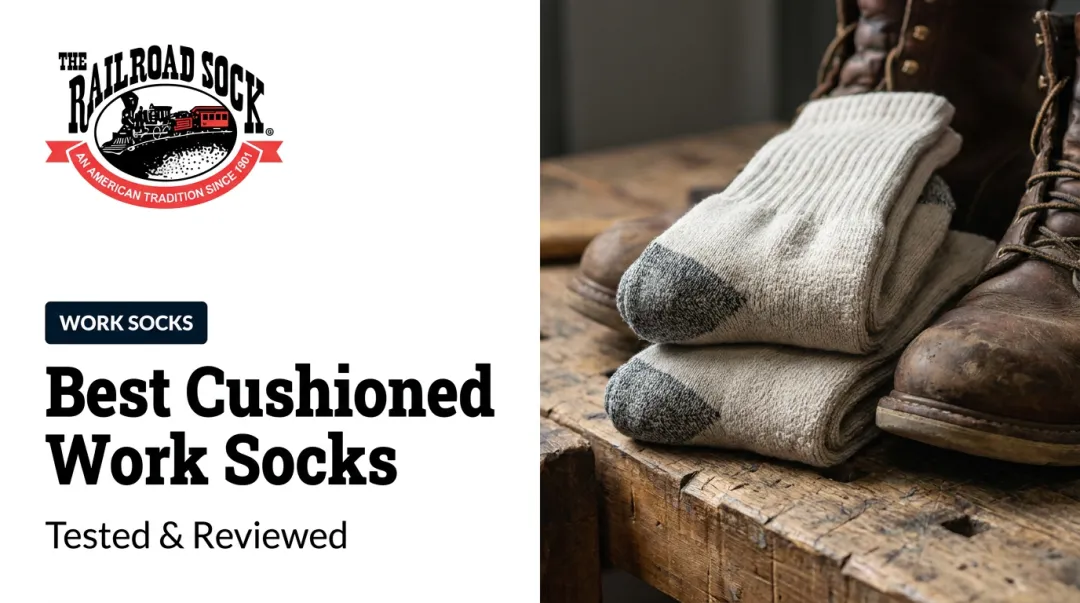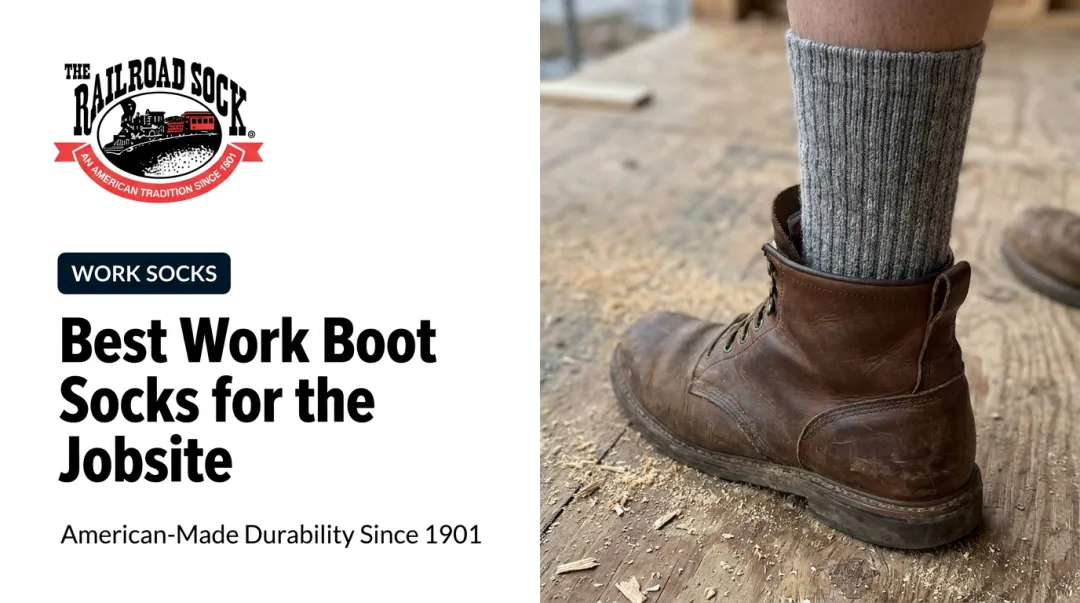

Cheap socks bunch up, trap sweat, and wear through at the heel within a few months. That means blisters, hot spots, and a productivity hit nobody talks about until they're limping to the truck at quitting time.
This guide ranks the best work socks for men in 2026 based on material, cushioning, durability, and real-world fit, including a heritage American-made option that's been on job sites since 1901.
Key Takeaways
- Reinforced heel/toe construction plus moisture-wicking fibers cuts blisters and fatigue on long shifts
- Merino wool and copper-infused blends beat cotton for odor control and temperature regulation
- A lifetime guarantee signals long-term value better than a low upfront price tag
- Steel-toe wearers need extra toe cushioning; cold-climate workers need heavier wool blends
- The Railroad Sock leads 2026 with two picks — the Men's Crew Work Socks (#6030) and the Steel Toe Boot Crew Socks (#6124), both made in the USA with a lifetime guarantee — followed by Darn Tough, Thorlo, and Wigwam
Why the Right Work Socks Matter
Your work sock is the interface between your foot and your boot for 8, 10, sometimes 12 hours a day. Get that interface wrong, and you're dealing with friction, sweat buildup, and foot fatigue that follows you home.
Thin, cheap socks slide down inside the boot. That creates pressure points at the heel and ball of the foot, which is exactly where blisters form. Cotton socks, meanwhile, soak up sweat and hold it against your skin instead of pulling it away.
That's part of why demand for durable, American-made work gear keeps climbing. The U.S. workwear market was valued at $3.50 billion in 2024, with a projected 3.61% annual growth rate through 2035, driven largely by men's construction and trade apparel.
Workers are paying closer attention to foot health and PPE-compliant gear than they used to.
Not every sock on the shelf is built for that job. The list below breaks down the top-performing options for 2026, based on material composition, cushioning placement, and durability backing.

The 5 Best Work Socks for Men in 2026
Each pick here was evaluated on reinforced construction, moisture management, and comfort technology. Warranty terms and suitability for specific work environments, whether that's a steel-toe boot, a warehouse floor, or a cold job site, also factored in.
The Railroad Sock – Best Overall American-Made Work Sock
The Railroad Sock has been manufacturing in the USA since 1901, when the brand first gained a following among railroad workers who needed socks that could survive a full shift on the rails. Today it offers over 100 styles across work, therapeutic, and outdoor lines, all still made domestically.
What sets it apart:
- Full-cushion and terry-cushioned foot designs for all-day padding
- Reinforced real heel and toe construction, not just a thicker knit
- Stay-up welt tops and ribbed leg construction to resist slipping inside boots
- Copper-infused yarn options for odor control in select lines
- A lifetime guarantee backing every pair, a rare commitment in a category dominated by disposable multipacks
The Men's Crew Work Socks, sold in a 3-pair pack, run around $10.49 and feature an 85% cotton, 15% nylon blend with built-in arch support. For workers who want heritage construction without paying boutique prices, this is the pick.
| Spec | Details |
|---|---|
| Material | 85% cotton, 15% nylon (Men's Crew Work Socks #6030); wool and poly blends elsewhere in the range |
| Key Features | Reinforced heel/toe, arch support, moisture-wicking, stay-up ribbed leg |
| Guarantee | Lifetime guarantee, made in the USA |
The Railroad Sock Steel Toe Boot Crew Socks – Best for Steel-Toe Boots
Alongside the Crew Work Socks above, The Railroad Sock makes a pair built specifically for safety toes: the Men's Steel Toe Boot Crew Socks, style #6124.
What matters most here is placement. The sock puts a flat toe seam and extra cushion in the foot bottom, the heel, and the top of the toe — the three zones that take the pressure inside a steel-toe or composite-toe shell. The foot top stays un-cushioned to cut bulk, so it doesn't crowd an already-tight toe box.
The fiber advantage over synthetic steel-toe socks is real: 70% cotton, 20% nylon, 10% Lycra breathes through a full shift instead of trapping sweat the way an 80% acrylic sock does.
| Spec | Details |
|---|---|
| Material | 70% cotton, 20% nylon, 10% Lycra |
| Key Features | Flat toe seam, cushion at foot bottom/heel/toe top, hi-splice heel, arch support, stay-up welt |
| Best For | Steel-toe and composite-toe boot wearers |
| Price | $8.99 per pair (style #6124; King Size #6124K) |
| Guarantee | Lifetime guarantee, made in the USA |
Darn Tough – Best Warranty-Backed Merino Wool Sock
This Vermont brand has built its reputation on merino wool boot socks and a warranty that borders on legendary. Darn Tough's policy states plainly that if a pair isn't the longest-lasting sock you've owned, you send it back for a new one. No receipt, no proof of purchase, no hoops to jump through.
The Steely Boot Midweight Work Sock stands out for its full-cushion terry loop construction underfoot, cushioned toe box built for steel-toe boots, and reinforced Achilles support. The moisture-wicking performance holds up shift after shift, keeping feet dry even through long stretches in insulated boots.
| Spec | Details |
|---|---|
| Material | 56% merino wool, 41% nylon, 3% Lycra spandex |
| Key Features | Full cushion, form-fitting calf, seamless toe |
| Price Range | Around $27 per pair |
Thorlo – Best Maximum Cushion for Concrete and Warehouse Floors
Thorlo built its entire brand around THOR-LON acrylic fiber, engineered specifically to absorb impact on hard surfaces. If your day is spent walking a warehouse floor or standing at a workbench on poured concrete, this is where cushioning density matters more than anything else.
The 12-Hour Shift line pairs light 12 mmHg compression through the calf with dense padding under the ball and heel. Thorlo describes this padding as clinically tested for friction protection, and while the specific study isn't publicly cited, the cushioning itself is noticeably thicker than most competitors.
| Spec | Details |
|---|---|
| Material | 69% THOR-LON acrylic, nylon, and elastic blend |
| Key Features | Dense heel/ball cushion, light 12 mmHg compression |
| Best For | Warehouse, factory, and concrete-floor workers |
Wigwam – Best for Cold Weather Work Environments
Wigwam has been making American wool socks for generations, and its cold-weather boot line reflects that focus. The 40 Below Wool Heavyweight Outdoor Sock uses a 49% wool blend built specifically for warmth retention without the itch that comes from lower-grade wool fibers.
For anyone working outdoors through winter, whether that's utility work, roofing, or ranch labor, this is the sock that keeps feet functional when temperatures drop.
| Spec | Details |
|---|---|
| Material | 49% wool, 51% stretch nylon |
| Key Features | Heavyweight warmth retention, full cushion |
| Best For | Cold weather and outdoor trade work |

How We Chose the Best Work Socks
The evaluation came down to five factors: fiber composition, cushioning placement, heel/toe reinforcement, warranty terms, and fit for specific boot types and climates. A sock that excels for a warehouse worker on flat floors won't necessarily hold up for someone climbing scaffolding in freezing weather.
Common buying mistakes worth avoiding:
- Choosing socks by price or brand recognition alone, ignoring fiber content entirely
- Overlooking cushioning zones, buying "cushioned" socks that pad the wrong part of the foot
- Mismatching sock height to boot shaft height, causing bunching or slippage
- Skipping warranty terms, then replacing socks every few months instead of once a year
Beyond steering clear of these pitfalls, two positive signals carried real weight in the rankings: Made in USA labeling and lifetime guarantees. Both point to a manufacturer's confidence in its stitching quality, which predicts long-term value far better than a low sticker price.
What to Look for When Buying Work Socks
Before you stock up, know what actually separates a good work sock from a bad one.
Material. Merino wool and copper-infused blends outperform cotton for a full workday. Texas A&M AgriLife's Howdy Health program advises against 100% cotton socks because cotton traps moisture against the skin, causing bunching, friction, and blisters. Wool pulls moisture and heat away from the foot instead.
Cushioning and reinforcement. Full-cushion or terry-cushioned foot designs, paired with reinforced heel and toe stitching, reduce blister risk and extend the sock's usable life. Look at where the padding sits, not just how thick the sock feels.
Fit and height. Crew, mid-calf, or over-the-calf lengths need to match your boot's shaft height. A crew sock in a tall logger boot will slide and bunch by lunchtime.
Compression and arch support. Light graduated compression in the 8-20 mmHg range can reduce fatigue for workers standing all day. A 2021 study of security guards found that regular socks led to significant lower-leg muscle fatigue and edema during prolonged standing, while compression stockings reduced both.
Durability guarantees. A lifetime guarantee, like the one backing every pair from The Railroad Sock, signals confidence in stitching quality that a $6 multipack simply can't match.

Conclusion
There's no single "best" work sock for every job. Steel-toe boots demand reinforced toe cushioning, while cold climates call for heavier wool blends. Standing all day, meanwhile, rewards arch support and light compression.
What should guide your decision is durability, American-made construction, and warranty backing, not just the price on the shelf tag. A sock that lasts twice as long at a slightly higher cost per pair is still the better deal.
If you're stocking your sock drawer for 2026, The Railroad Sock's work sock line is worth a look. It's built on 120+ years of American manufacturing, backed by a lifetime guarantee, and priced for workers who need reliable gear every day of the year.
Frequently Asked Questions
What are the best socks for working on your feet all day?
Socks with reinforced heel/toe cushioning, moisture-wicking merino wool or copper-infused fibers, and light arch compression perform best for all-day standing. They reduce fatigue and blister risk far better than basic cotton crews.
Who makes the best men's work socks?
Top-performing brands include heritage American manufacturers like The Railroad Sock, backed by a lifetime guarantee, along with Darn Tough, Thorlo, and Wigwam. Each excels in a different category, from warranty terms to cold-weather warmth.
How often should I replace my work socks?
Quality work socks typically hold up for 6-12 months with daily wear, though there's no universal lifespan. Wool and reinforced blends generally outlast cheap cotton multipacks by a wide margin.
Is cotton or wool better for work socks?
Wool, especially merino, outperforms cotton for moisture control and odor resistance. Cotton is more affordable upfront, but it retains sweat and breaks down faster under daily wear.
What socks should I wear with steel-toe boots?
Look for socks with extra cushioning over the toe box and heel, such as The Railroad Sock's Steel Toe Boot Crew Socks (#6124), which add a flat toe seam and cushion at the foot bottom, heel, and top of the toe. This padding prevents the pressure points that cause blisters inside rigid boots.
Do compression socks help reduce foot fatigue at work?
Yes. Light graduated compression in the 8-20 mmHg range improves circulation and reduces swelling for workers who stand or walk through long shifts.