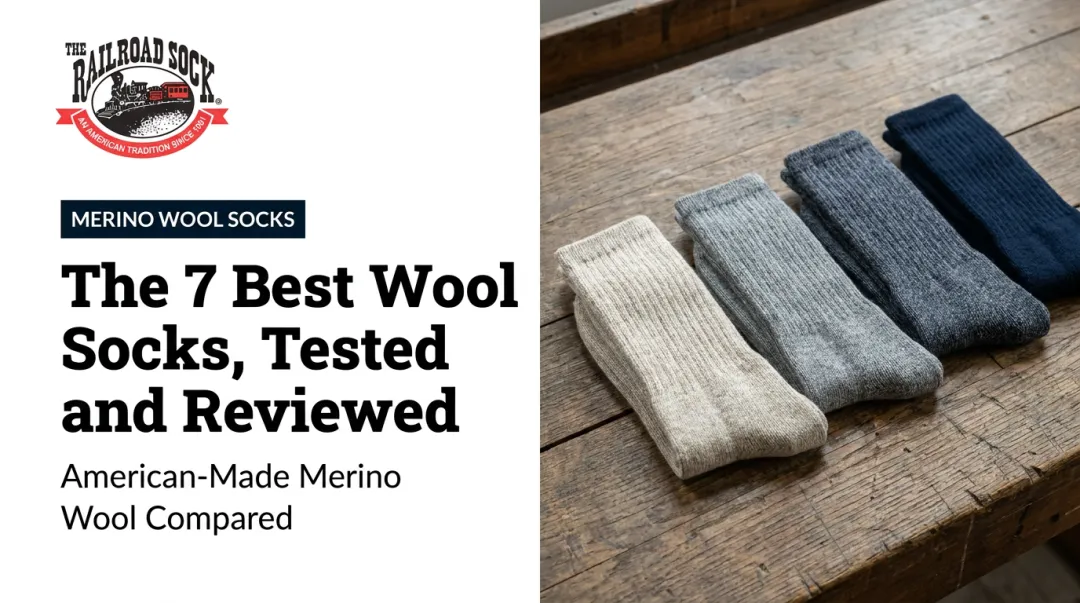

But not all "wool socks" deliver the same results. Fiber type, blend percentage, and construction quality all shape how a sock actually performs on your foot. A sock labeled "wool" could be 20% wool and 80% acrylic, and you'd never know until it wears thin after three washes.
We tested and reviewed the top wool socks for men across work, hiking, dress, and lounging categories. Below, you'll find our picks along with a breakdown of what actually separates a great wool sock from a mediocre one.
Key Takeaways
- The Railroad Sock's Men's Merino Wool Crew Socks (#2965) take Best Overall: a 50% merino blend, full terry cushion, made in the USA, lifetime guarantee
- Merino wool blends (40-70%) balance warmth, moisture control, and durability best
- Choose socks by use: reinforced heels for boots, cushioning for hikes, thin knit for dress
- Reinforced heel-and-toe stitching and a lifetime guarantee mean better long-term value
- Cold-water washing and air-drying (no fabric softener) make wool socks last longer
Why Wool Socks Matter for Men
Wool fibers do something cotton simply can't: they manage moisture from the inside out. According to Woolmark, that absorption happens gradually, keeping temperature steady against your skin instead of letting it swing between damp and cold.
That's why wool works for both January job sites and July hikes. It regulates rather than just insulates. The numbers back this up:
- Absorbs up to 35% of its own weight in water vapor before feeling wet
- Holds roughly 2x more moisture than cotton and 30x more than polyester
- Retains 66% less odor intensity than polyester and 28% less than cotton, per Woolmark's odor resistance research

Men who wear boots or work shoes for long shifts know the smell problem well: synthetic socks trap sweat, and trapped sweat means odor. Merino's structure binds odor-causing compounds instead of just holding onto moisture where bacteria thrive.
The socks below were chosen and tested across the categories where these properties matter most: work, outdoor activity, dress wear, and everyday comfort around the house.
Top Wool Socks for Men, Tested and Reviewed
We evaluated each pick for durability, warmth, moisture control, fit, and value across real-world wear, from full work shifts to weekend hikes to lazy Sunday mornings.
The Railroad Sock Men's Merino Wool Crew Socks (Best Overall)
The Railroad Sock has manufactured socks domestically since 1901, when railroad crews needed footwear tough enough to survive a full shift on the tracks. That same purpose-built approach carries into the Men's Merino Wool Crew Socks (1pr) — style #2965, the pair the brand calls its "Do Everything Sock."
At 50% merino wool, 35% acrylic, 13% nylon, and 2% spandex, it sits right in the 40-70% merino band that balances warmth, moisture control, and durability best. The acrylic and nylon are what let it survive repeated washing without felting or losing shape, which is exactly where thinner high-merino socks fail first.
What makes it our top pick:
- Full terry cushion bottom that carries you through a full day standing in boots
- Nylon-reinforced heel and toe at the two spots every sock wears through first
- Flat toe seam and a built-in arch support band to cut friction and fatigue
- 3x1 ribbed leg with a stay-up top that won't slide down inside a work boot
- Made in the USA and backed by a lifetime guarantee at $12.99 a pair
Year-round is the real selling point here: the weight is tuned to keep feet dry and comfortable on the warmest and the coldest days, so it works for a January job site, a fall hike, and everyday boot wear without you owning three different socks.
| Attribute | Details |
|---|---|
| Material | 50% merino wool, 35% acrylic, 13% nylon, 2% spandex |
| Best For | Work boots, job sites, hiking, cold-weather daily wear |
| Price | $12.99 per pair (style #2965) |
| Standout Feature | American-made construction backed by a lifetime guarantee |

Darn Tough Merino Wool Boot Socks (Best Warranty-Backed Pick)
Darn Tough built its reputation on rugged Vermont-knit construction and a merino wool cushion that holds up through years of hard wear. The company backs every pair with an unconditional lifetime guarantee against wear-through, no receipt required.
What sets these apart:
- Reinforced heel and toe that resist the first wear-through spot on most socks
- Snug, non-slip fit that stays put in boots and hiking shoes alike
- Versatile enough for daily boot wear or weekend trail use
In OutdoorGearLab's testing, the Hiker Full Cushion model logged over 200 miles and scored 9 out of 10 for durability, with only minor pilling at the heel and midfoot.
| Attribute | Details |
|---|---|
| Material | Merino wool and nylon blend for warmth and durability |
| Best For | Boots, hiking, cold-weather daily wear |
| Standout Feature | Lifetime replacement guarantee |
Boardroom Merino Wool Dress Socks (Best Dress Socks)
Boardroom's fine-gauge knit disappears under dress shoes while still doing wool's job of managing temperature and moisture through a full workday.
Why they stand out:
- Machine-washable wool with no dry-cleaning hassle
- Flat-seam toe that eliminates the bulk you'd feel with a bulky work sock
- Over-the-calf fit that stays put through meetings, flights, and long commutes
| Attribute | Details |
|---|---|
| Material | Merino wool, nylon, and spandex blend |
| Best For | Office wear, dress shoes, and formal occasions |
| Standout Feature | Reinforced heel/toe with a seamless, blister-resistant toe |
L.L.Bean Merino Wool Ragg Socks (Best for Hiking & Outdoor)
These heavyweight, ragg-knit socks hold their shape through long days on the trail. We tested them across multiple hikes exceeding 20,000 steps and noticed no sagging or bunching by the end.
Standout points:
- Strong temperature regulation across changing trail conditions
- Cushioning and shape retention that survives repeated heavy wear
- Sold in a practical two-pair pack
| Attribute | Details |
|---|---|
| Material | Merino wool, stretch nylon, and Lycra elastane |
| Best For | Hiking, cold-weather outdoor activity, boots |
| Standout Feature | Maintains shape and cushioning over long wear |
Druthers Relacks Merino Wool House Socks (Best for Lounging)
The loopback terry interior on these house socks feels closer to walking on carpet than wearing a sock. It's a different category entirely from performance wool socks, built purely for comfort at home.
Why they work:
- Non-mulesed organic merino wool for a genuinely soft feel against skin
- Solid temperature regulation on cold hardwood or tile floors
- Plush enough that you'll forget you're wearing socks by hour two
| Attribute | Details |
|---|---|
| Material | Organic merino wool and recycled poly blend |
| Best For | Lounging, working from home, cold floors |
| Standout Feature | Ultra-plush terry cushioning underfoot |
Bombas Merino Wool Blend Crew Socks (Best Multipack Value)
Bombas built a snug, non-slip everyday crew sock and sells it in multipacks that reward buying more than one pair at a time.
What makes them worth the multipack price:
- Seamless toe construction across the line
- Arch support built into the knit, not added as an afterthought
- Consistent quality pair to pair, which matters when you're buying four or eight at once
| Attribute | Details |
|---|---|
| Material | Merino wool, polyester, and elastane blend |
| Best For | Everyday wear, errands, casual use |
| Standout Feature | Multipack pricing for cost-conscious buyers |
How We Chose the Best Wool Socks for Men
We didn't rank these off spec sheets alone. Each pair went through hands-on wear testing across work shifts, hikes, commutes, and lazy weekends. We tracked how comfort and durability held up over repeated use, not just on day one.
Common buying mistakes we tried to steer readers away from:
- Choosing by price alone and ending up with a thin sock that wears through in weeks
- Ignoring wool percentage and buying a "wool sock" that's mostly acrylic
- Skipping construction details like reinforced heels, which is where socks fail first
We weighted construction quality heavily: reinforced heel-and-toe, arch support placement, and seam type. Just as important was whether a brand stands behind its product with an actual warranty or guarantee, rather than vague durability claims.
What to Look for When Buying Wool Socks for Men
Fiber Type and Wool Content
Wool quality varies by fiber type. Regular sheep's wool can feel coarse against skin, while merino wool uses finer fibers for a softer feel and better moisture control. Wool blends add nylon or spandex for stretch and durability that pure wool lacks.
- 40-50% wool works well for everyday wear where softness and comfort matter most
- 60-70% wool suits high-impact use like hiking or work, where durability under stress matters more
- 100% wool sacrifices durability, since it lacks the reinforcing fibers that resist abrasion

Weight, Height, and Construction
Sock weight and height should match your activity:
- Lightweight socks suit dress shoes and warmer climates
- Midweight to heavyweight crew or boot-height socks handle cold weather and boot wear
- Taller heights (boot or over-the-calf) add coverage and warmth for outdoor or work use
Beyond weight and height, construction details separate socks that last years from ones that die in months:
- Reinforced heel-and-toe areas, since these wear out first
- Arch support bands that reduce foot fatigue during long days
- Stay-up welt tops that keep the sock from sliding down inside boots
Moisture Control and Warranty
Men wearing boots or work shoes for extended shifts need socks that actively manage sweat, not just absorb it. Wool's natural antimicrobial properties reduce odor buildup far better than synthetic-only socks, which matters after hour six of a work shift.
Comfort features mean little without durability behind them. A brand willing to guarantee its socks for life is confident in its construction. The Railroad Sock, for example, backs every pair with a lifetime guarantee, a strong signal when you're deciding between a $10 sock and a $20 one.
Conclusion
The best wool socks for men aren't defined by price tag or brand recognition alone. They come down to wool content, construction quality, and whether the sock actually matches how you'll use it.
Match your sock to your day: work boots need reinforcement, trails need cushioning, dress shoes need a thin breathable knit, and lounging around the house calls for pure comfort. Get that match right, and you'll notice the difference by the end of your first wear.
Once you know what to look for, choosing a trusted brand makes the decision easier. If you need dependable, American-made wool socks for work and everyday use, The Railroad Sock's wool blend styles come backed by a lifetime guarantee. That guarantee reflects the same job-site-tested philosophy the brand has followed since 1901.
Frequently Asked Questions
What percentage of wool is best for socks?
Most quality wool socks use 30-80% wool blended with synthetics. Aim for 40-50% for everyday wear and 60-70% for high-impact activities like hiking or work.
Are wool socks warmer than cotton socks?
Yes, wool insulates even when damp and regulates temperature, while cotton retains moisture and can leave feet cold and uncomfortable.
How do I wash wool socks without shrinking or damaging them?
Wash inside out in cold water on a gentle cycle with mild detergent. Skip fabric softener and air-dry flat to preserve shape and fiber quality.
Can men wear wool socks in warm weather?
Yes, lightweight merino wool blends are breathable enough for summer use. They wick moisture and avoid the sweaty discomfort cotton causes.
Are merino wool socks worth the extra cost for everyday use?
Yes, merino's durability, odor resistance, and comfort offset the higher upfront cost through longer sock life and fewer replacements over time.
How often should work socks be replaced?
Quality wool work socks with reinforced heels and toes can last a year or more with regular wear. Replace them once cushioning thins or holes develop.